Borers
Beetle and moth larvae that tunnel through the living tissue just under the bark. With the sole exception of emerald ash borer, they are opportunists that attack trees already weakened by drought, heat, or damage — which makes an infestation a diagnosis of the tree's history, not just its pests.
Serious. Capable of killing branches, sections, or eventually the whole tree. Often a symptom of an underlying stress that matters more than the organism itself.
What you see
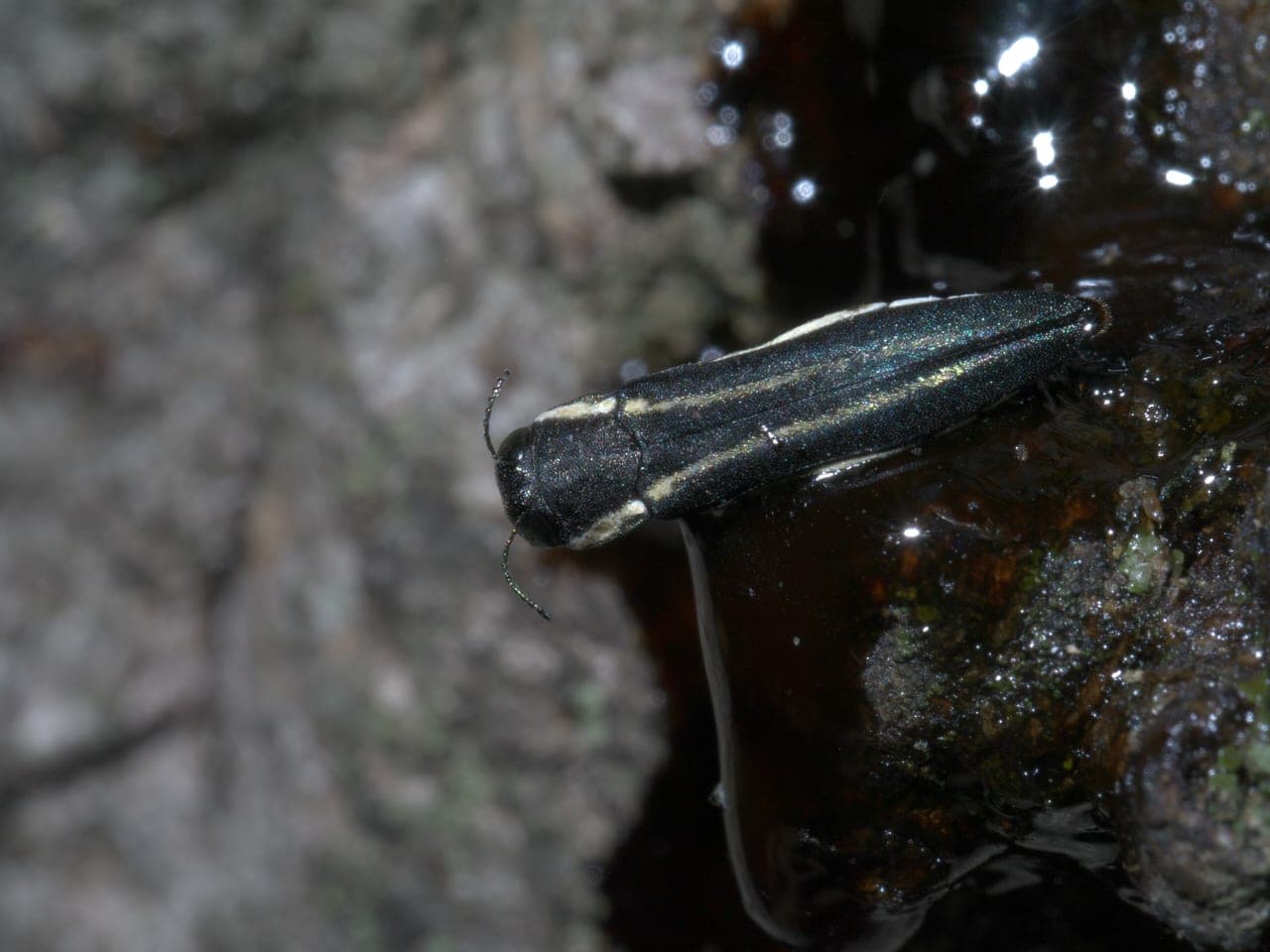
- Round, oval, or D-shaped holes in the trunk and larger limbs
- Coarse sawdust or fine frass packed in bark crevices or piled at the base
- Sap, gum, or wet staining running from small holes
- Canopy dieback that begins at the top and progresses downward over one to three seasons
- Bark that sounds hollow, loosens, or flakes away over tunnelled wood
- Woodpecker activity concentrated on specific limbs
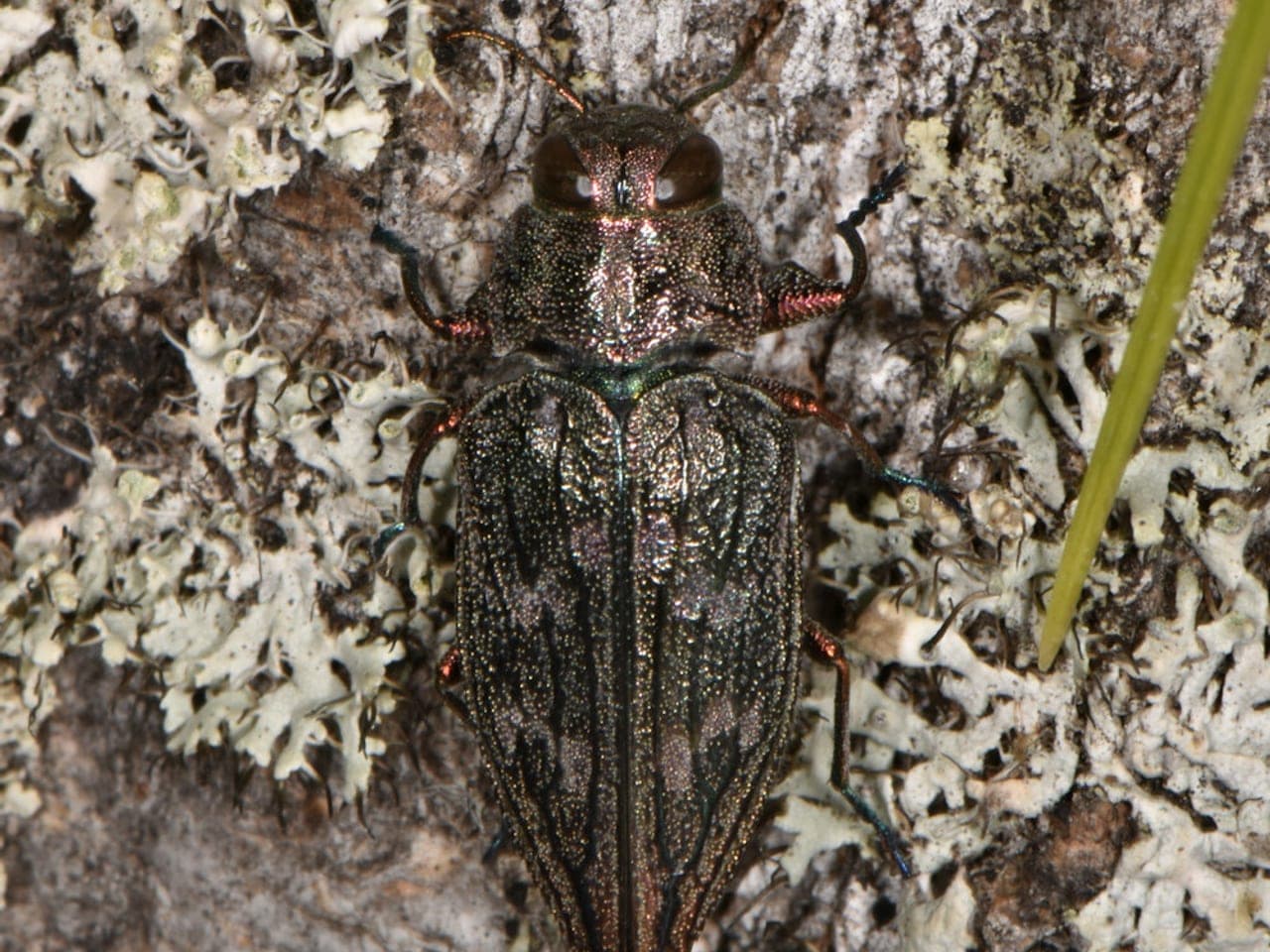
Flatheaded appletree borer, a specialist in newly planted and sunscalded trunks. Young trees with damaged bark are its target. 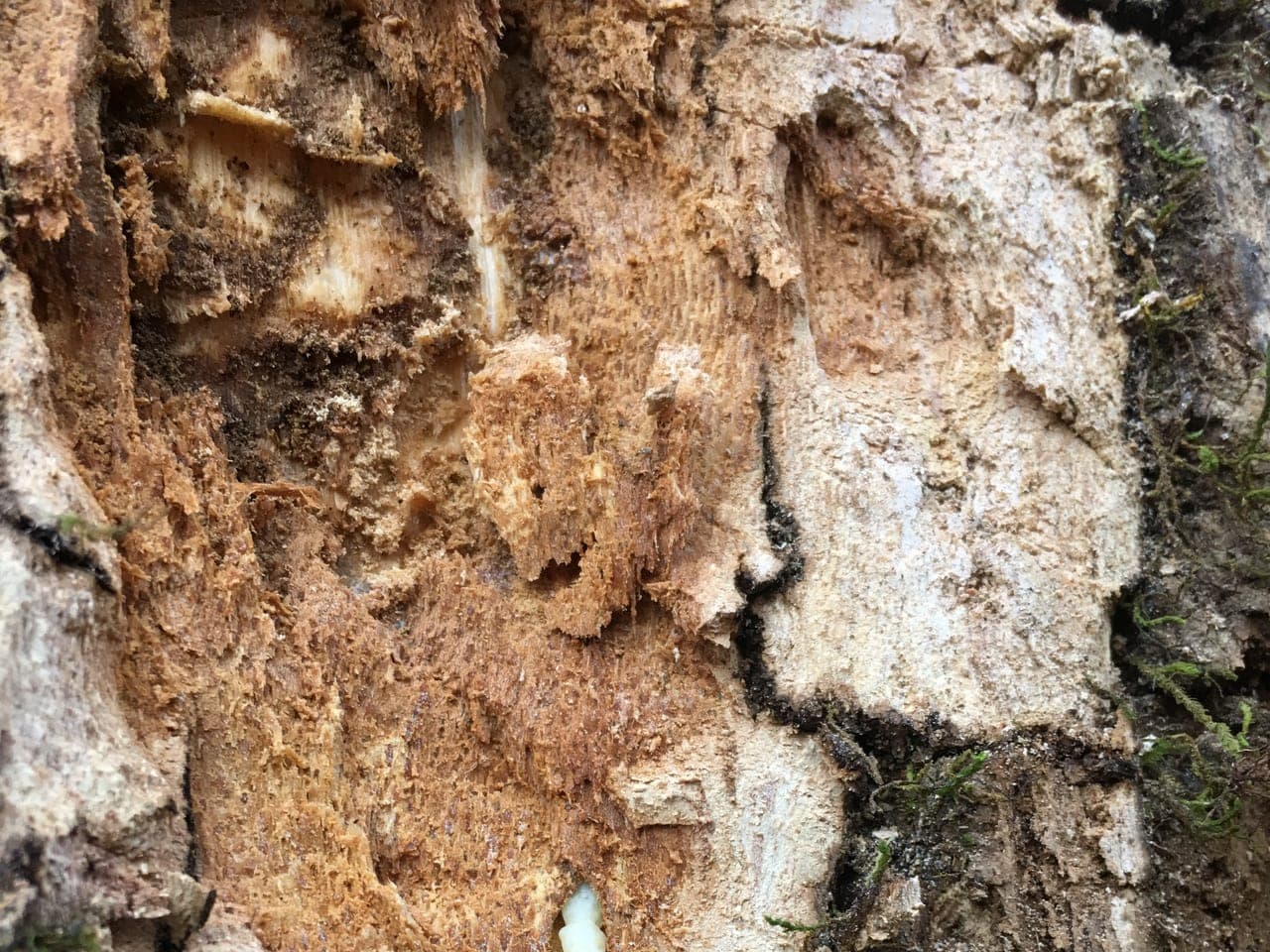
Where woodpeckers have stripped bark to reach larvae. The tunnelling is in the thin living layer that carries water up the tree.
How to be sure: Peel a loose flake of bark on a dying limb. Borer galleries are packed with sawdust and cut across the grain in the living layer — decay and drought damage do not leave tunnels.
Trees it affects in Kansas
Also affects: Birch, Peach and other stone fruit, Dogwood, Lilac, Newly planted trees of most species.
When it happens in Kansas
April – June
Adults emerge and fly, seeking stressed trees to lay eggs on. This is the only stage exposed on the outside of the bark, and therefore the only stage a preventive bark spray can reach.
May – August
Larvae hatch and tunnel into the living tissue. Damage accumulates invisibly. A tree stressed by the previous summer's drought is being colonized now.
Late summer
Canopy symptoms appear — usually a full year or more after the attack began. This lag is why borers are so often blamed for a decline they merely finished.
Fall – winter
Larvae overwinter under the bark. Woodpeckers work infested limbs, which is often the clearest external sign available.
Prevention
- Water deeply through Kansas droughts — this is genuinely the primary control for every borer except emerald ash borer
- Keep mowers and string trimmers away from trunks, since bark wounds are the standard entry point
- Protect thin-barked young trees from winter sunscald on the south and southwest side with a light-coloured wrap or, better, a low branch left in place
- Do not pile mulch against the trunk, which keeps bark soft and wet and invites entry
- Avoid pruning during peak adult flight where a species is known to be a local problem
Treatment options
What you can do yourself
Water and root-zone careThrough every dry spell, year round
The most effective borer treatment available to a homeowner, and it is not a pesticide. A vigorous tree walls off attacks that overwhelm a drought-stressed one. Deep, infrequent soaking out at the drip line, not a daily sprinkling.
Pruning out infested limbsDormant season, avoiding oak pruning between April and July
Removes the larvae inside along with the wood. Take affected limbs back to sound tissue and get the prunings off the property rather than stacking them nearby.
What treatment actually achieves
Nothing you spray on the outside of a tree reaches a larva already tunnelling inside it. That single fact governs the whole subject: borer work is preventive, and by the time the canopy is thinning the useful decisions are about the trees around it rather than the one in front of you. Ask what stressed this tree — a dry summer two years ago, a trench for a utility line, soil piled over the roots during a build — and fix that.
When the tree may not be recoverable
- More than half the canopy dead, with fresh exit holes still appearing on the trunk
- Bark loose or sloughing over extensive galleries around a significant part of the trunk circumference
- Galleries that have girdled the trunk — nothing above a complete ring of destroyed tissue can be saved
- Dieback continuing to advance downward through a second and third season despite watering
Common questions
Are borers what killed my tree, or did something else?
Usually something else started it. Except for emerald ash borer, nearly every borer in Kansas is a secondary attacker that succeeds only on trees already weakened. Finding borers tells you the tree was in trouble; it rarely tells you why.
There are holes in my trunk in neat horizontal rows. Is that a borer?
No — that is a sapsucker, a woodpecker that drills orderly rows of shallow wells to feed on sap. Borer holes are scattered and irregular. Sapsucker damage looks worse than it is.
Can I inject something to kill the larvae inside?
Sometimes, for some species, with mixed results. It is worth a proper identification first, because half the systemic treatments sold for borers do not work on the borer you actually have.
Kansas Tree Guide is an independent educational resource. Nothing on this site replaces an on-site assessment by a qualified arborist or tree-care professional. Last reviewed August 2026.