Hypoxylon canker
Biscogniauxia atropunctata
A fungus that lives quietly inside healthy oaks and only turns destructive when the tree is severely stressed — most often by drought. Bark sloughs away in sheets to reveal a silver-grey crust, and by the time you can see it, that part of the tree is already dead.
Usually fatal. Once established in a susceptible tree, this generally ends in removal. Effort is better spent protecting the trees nearby than saving the one already infected.
What you see
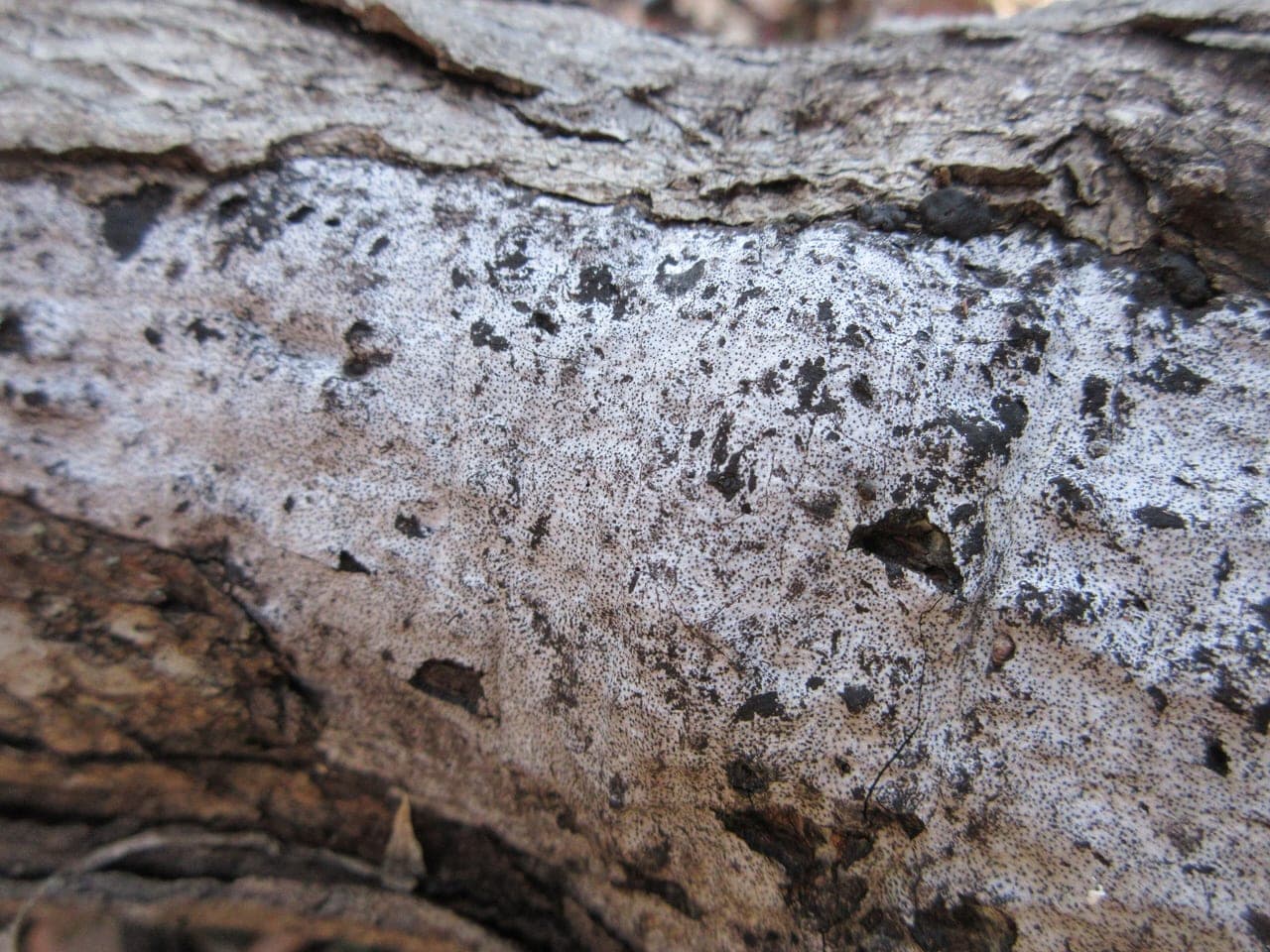
- Bark falling away from the trunk or large limbs in plates, often with no obvious wound
- A smooth silvery-tan crust on the exposed wood, weathering to olive-brown and finally to a hard black crust
- A powdery olive or brown spore dust that comes off on your hand
- Canopy thinning and dieback, usually from the top down
- Dead branches and sections of trunk with no other visible cause
- Sapwood beneath the crust that is dry, discoloured, and brittle
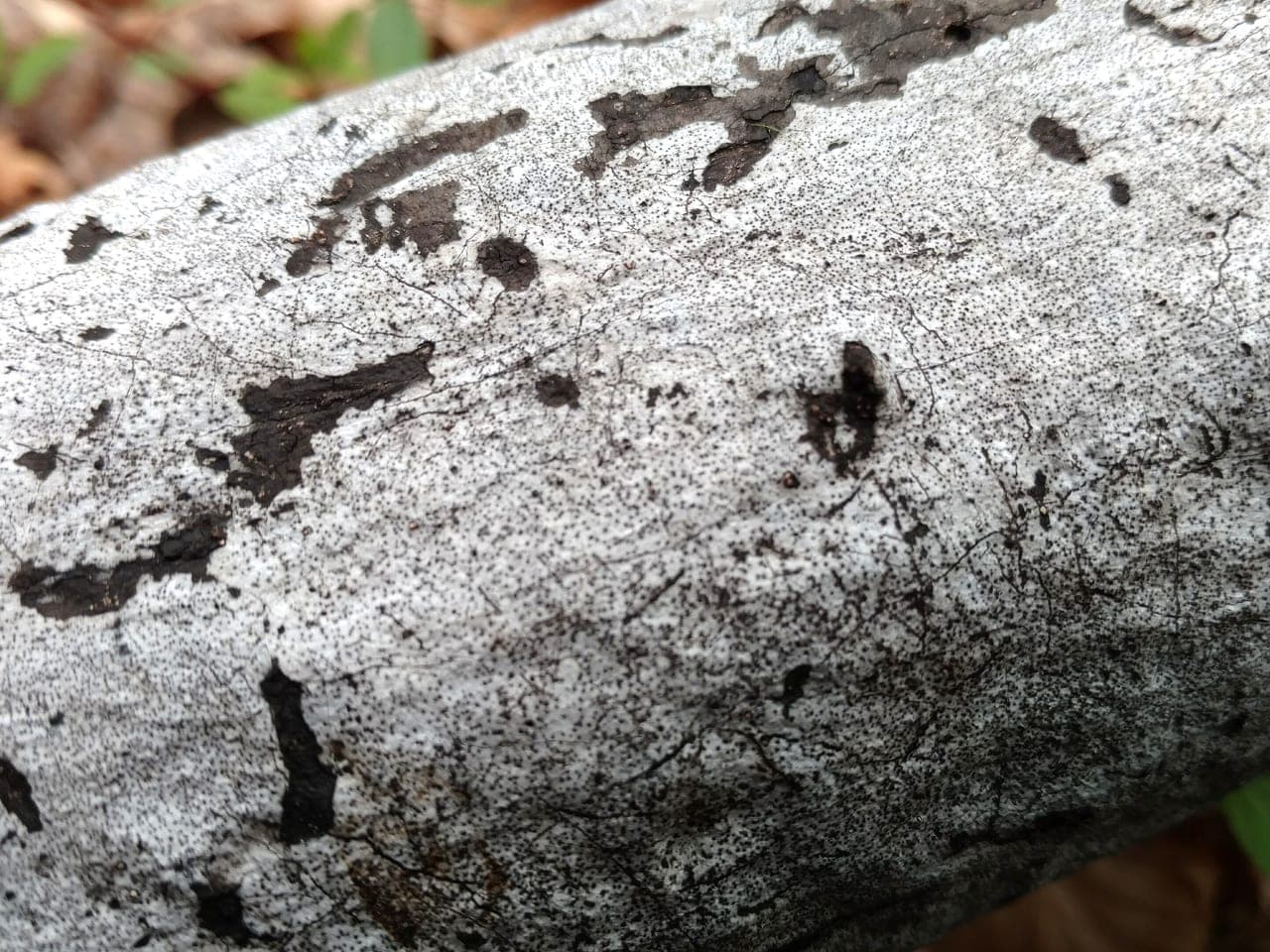
The same fungus later on. Wood under a crust like this is dry and brittle, and the limb or trunk above it is not reliable.
How to be sure: The colour sequence on exposed wood — silver to olive to black crust — under bark that has fallen off rather than been damaged. Nothing else in a Kansas oak looks like it.
Trees it affects in Kansas
Also affects: Post oak, Blackjack oak, Hickory, Elm, Maple, Sycamore.
When it happens in Kansas
Year round
The fungus is present inside apparently healthy trees as a latent endophyte, doing nothing at all. It is not something a tree catches when it gets sick — it is already there.
During and after drought
Severe water stress lets the fungus switch to actively colonizing the sapwood. Kansas drought years are the trigger, and the visible damage typically follows a year or two later.
Summer – fall
Bark sloughs and stromata appear on the exposed wood. This is when most people notice, and it is well after the wood beneath has died.
Following seasons
The crust darkens and hardens, decay advances, and affected trunks and limbs become structurally unreliable.
Prevention
- Water mature oaks deeply during Kansas droughts — this is the only meaningful prevention there is
- Protect the root zone from construction, trenching, grade changes, and compaction, which are the other reliable triggers
- Avoid root damage from trenching for irrigation, cable, or fencing anywhere near a mature oak
- Mulch out toward the drip line to moderate soil temperature and moisture, keeping it clear of the trunk
- Do not thin or heavily prune an already drought-stressed oak, which adds stress at the worst possible time
Treatment options
What you can do yourself
Water and root-zone protectionThrough every dry period
For an oak that is stressed but not yet showing stromata, deep watering through drought is genuinely preventive. This is the whole of the useful treatment, and it works only in advance.
Protecting the trees nearbyOngoing
The fungus is already latent in the neighbouring oaks. Whether it ever expresses depends on how stressed those trees get, which is something watering and root protection genuinely influence.
What treatment actually achieves
There is no fungicide and no treatment for an oak already showing stromata on the trunk — the affected wood is dead and the fungus is inside it. What makes this entry worth reading anyway is that it is almost purely a stress disease: the fungus is in healthy oaks all around Kansas doing nothing, and drought is what wakes it. That makes the watering of mature oaks during dry summers a genuinely preventive act rather than a hopeful one.
When the tree may not be recoverable
- Stromata over a significant part of the trunk — that section of trunk is dead and the tree is structurally compromised
- Bark sloughing from large areas of the main stem
- More than half the canopy in decline alongside visible stromata
- Any affected trunk on a tree standing within reach of a house, drive, or gathering area should be assessed as a hazard rather than a patient
Need professional help in the Wichita area?
Hypoxylon canker usually ends in removal, and a dead tree near a house, drive, or play area is a structural problem rather than a horticultural one. A professional assessment settles both questions at once.
When a situation calls for professional help in the Wichita area, we refer readers to Kohnen's Tree Service, a working Kansas tree-care company whose field experience informs this site. That relationship is disclosed here and on our About page.
Common questions
The bark is falling off my oak in sheets. Is that this?
It is one of the main possibilities, particularly a year or two after a dry summer. Look at the exposed wood: a smooth silver-grey crust that weathers olive and then black is characteristic. Bark shedding with clean sound wood underneath is a different and far less worrying story.
Can I save the tree if I water it now?
Not the parts already affected — that wood is dead. Watering matters for the rest of the tree and, more importantly, for the other oaks on the property that are carrying the same latent fungus and have not been pushed far enough to express it.
Is it contagious to my other oaks?
Not in the ordinary sense. The fungus is already inside most healthy oaks, living harmlessly. What spreads is not the organism but the stress — which is why a drought year tends to produce several affected trees at once across a neighbourhood.
Kansas Tree Guide is an independent educational resource. Nothing on this site replaces an on-site assessment by a qualified arborist or tree-care professional. Last reviewed August 2026.