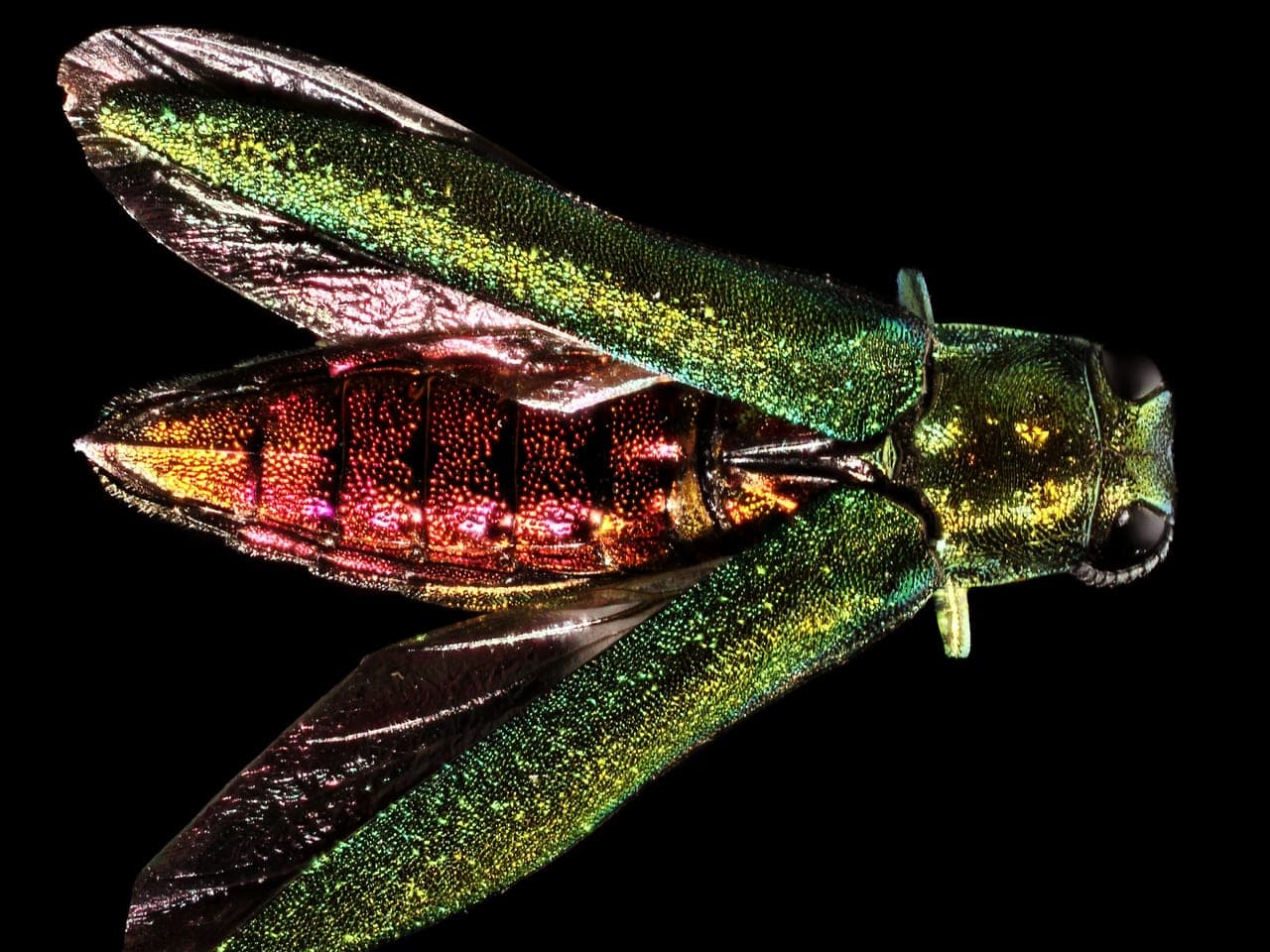
Emerald ash borer
Agrilus planipennis
An invasive beetle that has killed essentially every untreated ash in the areas it has reached, and it is still moving across Kansas county by county. An ash you want to keep has to be on a treatment program before it looks sick — once a third of the canopy is gone, the window has closed.
Usually fatal. Once established in a susceptible tree, this generally ends in removal. Effort is better spent protecting the trees nearby than saving the one already infected.
What you see
- Thinning that starts at the very top of the canopy and works downward
- Sprouts breaking out of the trunk and lower limbs while the top dies back
- Pale patches of bark where woodpeckers have flaked off the outer layer chasing larvae
- Sharp-edged D-shaped exit holes about an eighth of an inch across
- Winding S-shaped tunnels packed with sawdust in the wood just under the bark
- Vertical splits in the bark over old tunnels
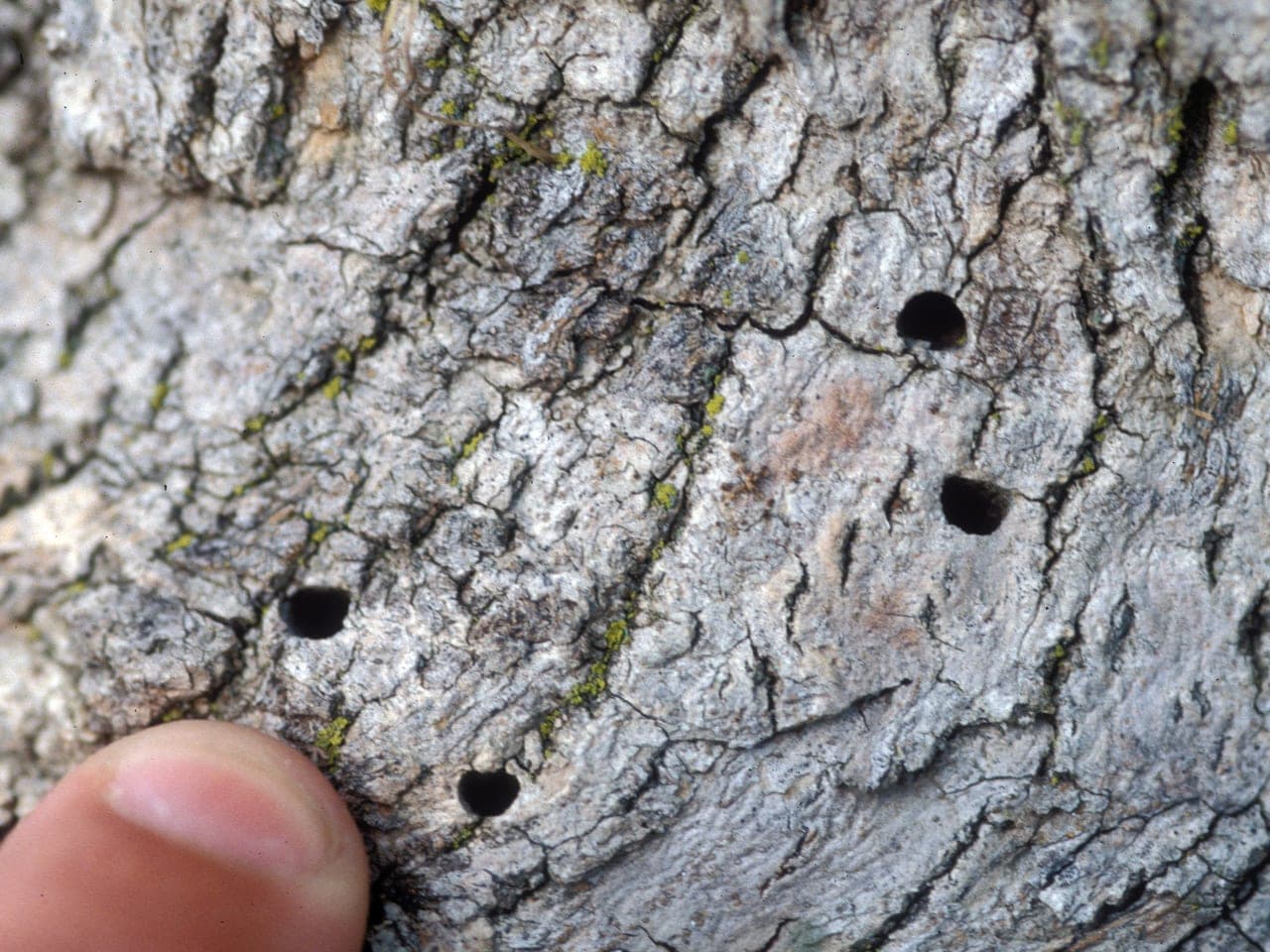
The D-shaped exit hole is the diagnostic sign. One flat side, one curved, roughly an eighth of an inch across. 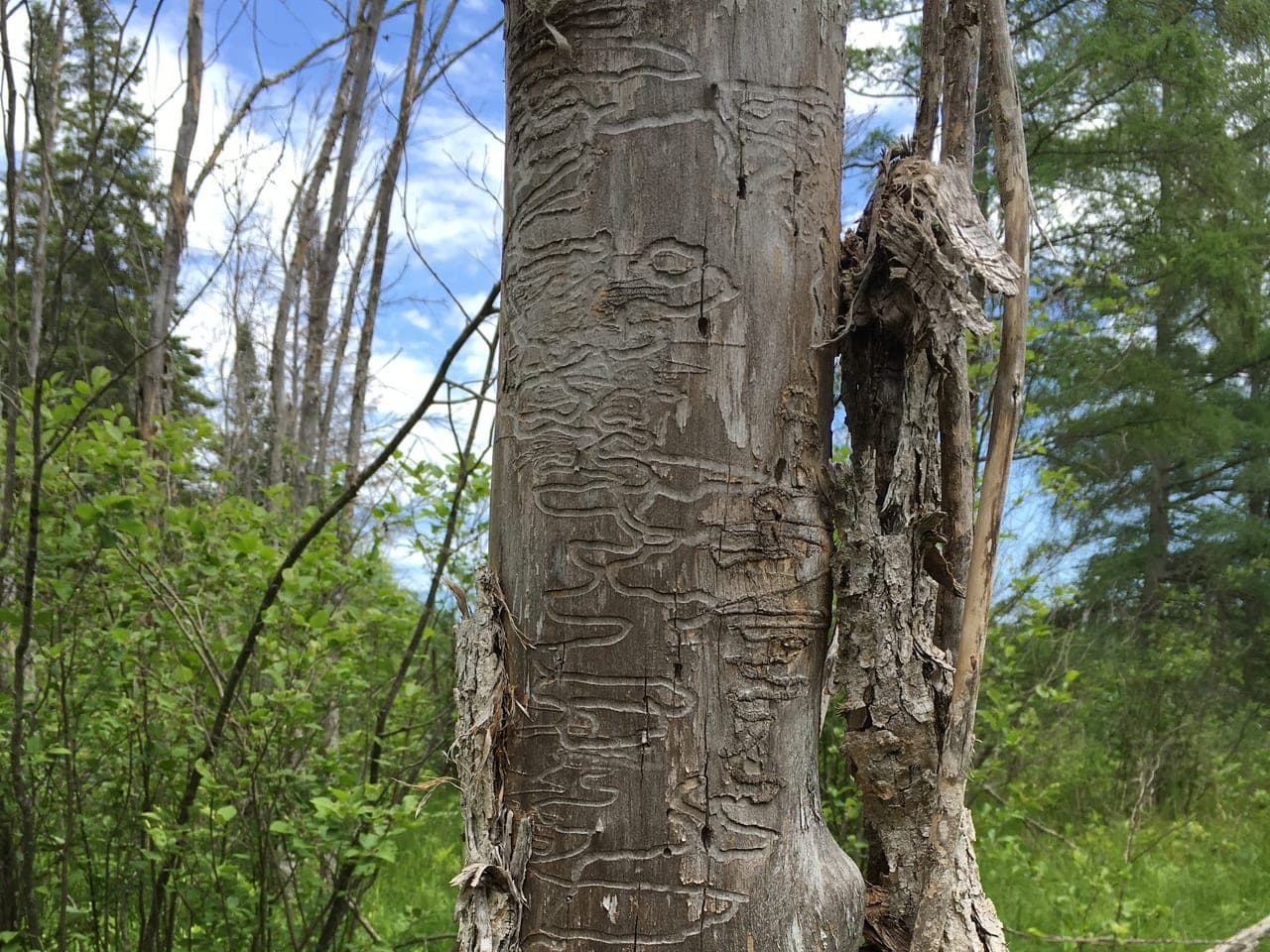
Under the bark, the winding S-shaped galleries sever the tissue carrying water to the canopy. This is why the top dies first.
How to be sure: The exit hole is a genuine D — one flat side and one curved — and about the width of a pencil lead. Every other borer in a Kansas ash leaves a round or oval hole.
Trees it affects in Kansas
Also affects: White ash, Black ash, Blue ash, Autumn Purple and other ash cultivars.
When it happens in Kansas
Late April – May
Larvae that fed all last season pupate under the bark. Nothing is visible from outside, and this is the last comfortable moment to get a preventive treatment in.
Mid-May – early July
Adults chew their way out, leaving the D-shaped holes, then feed on ash leaves and mate. Peak emergence in eastern Kansas is usually the first three weeks of June.
June – August
Females lay eggs in bark crevices. Larvae hatch and begin tunnelling through the tissue that moves water up the tree.
September – March
Larvae overwinter under the bark. Woodpeckers work them over through winter, which is why blonded bark is often the first thing anybody notices — usually in the second or third year of infestation.
Prevention
- Decide early whether each ash is worth keeping — a healthy, well-placed, structurally sound tree is; a crowded or declining one is not
- Start preventive trunk injection before symptoms appear, once the beetle is confirmed within roughly fifteen miles
- Keep the tree watered through Kansas summers, since drought-stressed ash are colonized faster and treated less successfully
- Never move ash firewood — this is how the beetle skips ahead of its own slow flight
- Plant something that is not an ash to take over the space, and start it now rather than after the ash comes down
Treatment options
What you can do yourself
Soil-applied imidacloprid drenchApril to mid-May, applied to moist soil
Poured around the base and taken up through the roots. Reasonable on trees under about fifteen inches in diameter, unreliable on larger ones, and it has to be repeated every year without fail. Read the label for restrictions near water and for flowering plants underneath.
What treatment actually achieves
Treatment works — but it is a permanent commitment, not a cure. The insecticide protects the tree while it is in the tissue and stops protecting it when it runs out, and the beetle does not leave the neighborhood. Budget for injections every two to three years indefinitely, and be honest about whether the tree is worth that. On a healthy specimen shading a house, it usually is. On a row of volunteer ash along a fence line, it is not.
When the tree may not be recoverable
- More than a third to a half of the canopy is already dead
- Bark is splitting and sloughing off the trunk over extensive galleries
- Vigorous sprouting along the trunk while the top is bare — the tree is spending its reserves on tissue that cannot support it
- The tree has been dead for a season or more, at which point it should be treated as a removal hazard rather than a tree
Need professional help in the Wichita area?
Preventive trunk injection has to be dosed to the tree and timed to the season, and the treat-or-remove decision is best made standing next to the ash in question. In the Wichita area, Kohnen's Tree Service runs EAB treatment programs and handles the removals when treatment no longer makes sense.
When a situation calls for professional help in the Wichita area, we refer readers to Kohnen's Tree Service, a working Kansas tree-care company whose field experience informs this site. That relationship is disclosed here and on our About page.
Common questions
How do I know if my tree is even an ash?
Ash has compound leaves with five to nine leaflets, and — the reliable part — branches, buds, and leaves arranged directly opposite each other rather than alternating along the twig. Very few Kansas trees do that. Mature bark forms tight diamond-shaped ridges.
Is it worth treating a tree that already looks thin on top?
It depends how thin. Under about twenty percent canopy loss, treatment often turns a tree around. Past a third, the tissue that carries the insecticide has itself been destroyed, and results fall off sharply. An arborist looking at the actual tree can make that call far better than a photograph can.
My neighbour's ash died. Will mine definitely get it?
If it is untreated, effectively yes. The beetle does not skip trees, and it does not lose interest. The useful question is not whether it will arrive but whether this particular tree earns a treatment program.
Can I just cut it down myself?
Please do not, once it has been dead a while. Ash killed by borer becomes brittle far faster than most species, drops limbs without warning, and behaves unpredictably under a saw. This is one of the clearest cases for hiring the work out.
Kansas Tree Guide is an independent educational resource. Nothing on this site replaces an on-site assessment by a qualified arborist or tree-care professional. Last reviewed August 2026.