
Kansas tree care
Looking after the tree you already have
Four jobs cover nearly all routine care: water, mulch, prune, protect. None of them are difficult and none of them need doing often — which is precisely why they go wrong. The trees that struggle in Kansas yards are rarely the neglected ones. They are the ones watered daily, mulched a foot deep, and pruned every spring by somebody who knocked on the door.
Most tree care goes wrong by doing too much, not too little
Mulch piled up the trunk
Two to four inches, held clear of the flare
A healthy mature canopy thinned every year
Pruned when there is a reason to prune
Ten minutes of sprinkler every evening
A long soak every few weeks, out at the drip line
Start here
How old is the tree?
Nearly every question below has a different answer depending on the age of the tree, and age matters far more here than species does. A bur oak and a silver maple planted last October want almost identical treatment. The same two trees at fifty want very little from you at all.
The cheapest years of the tree's life to fix anything, and the ones most often skipped.
- Water
- A deep soak every two or three weeks through dry spells, over a widening area.
- Mulch
- Widen the ring as the canopy spreads instead of topping up the same small circle.
- Prune
- This is the window. Light structural pruning every two to three years sets the architecture.
- Protect
- Keep turf, equipment, and traffic outside the ring while roots are colonizing soil.
What goes wrong at this age. Skipping structural pruning. Weak unions cost a few seconds to correct at eight feet and thousands to address at forty.
Water
Deep and infrequent, out where the roots actually are.
The numbers
- How much
- 10–15 gallons per inch of trunk diameter, poured slowly
- Newly planted
- On the root ball itself, two or three times a week for the first month
- Established
- Out past the branch tips, every two to four weeks in a dry summer
- Deep enough when
- A long screwdriver pushes in 8–12 inches without forcing
- How to water newly planted trees
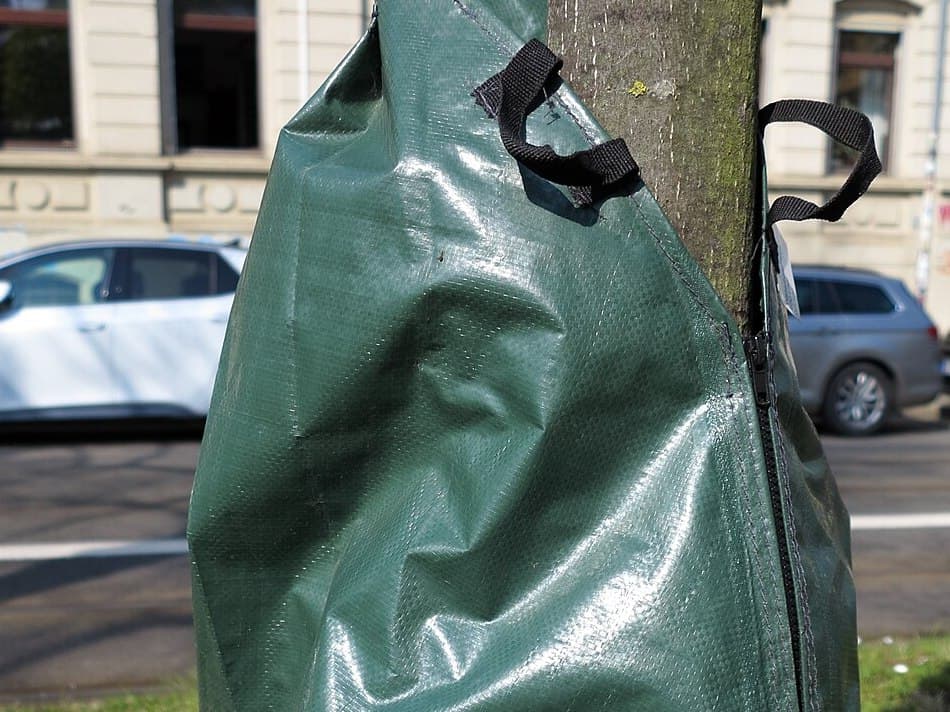
- A new tree can only drink from the root ball it arrived with, so water that, not the lawn around it. Give it 10 to 15 gallons per inch of trunk diameter, poured slowly enough to soak in rather than run off, two or three times a week for the first month and then weekly through the first two growing seasons. In Kansas it is usually wind, not heat, that dries a new root ball fastest — a windy 80-degree day takes more out of it than a still 95-degree one.
- How to water mature trees
- Established trees need water far less often but over a much wider area. The absorbing roots are in the outer two-thirds of the root zone and well past the branch tips, so watering at the trunk mostly misses them. Soak slowly to a depth of 8 to 12 inches, once every two to four weeks through a dry Kansas summer. Push a long screwdriver into the ground afterwards: if it slides in easily you have reached depth, and if it stops short you have not.
- How to care for trees during drought
- Triage by what cannot be replaced. Newly planted trees come first, then mature shade trees you would miss, then everything else — lawns recover from a bad summer and a sixty-year-old oak does not. Water deeply and less often rather than lightly and daily, renew mulch to hold what you apply, and skip fertilizer entirely: it pushes new growth the roots cannot currently supply.
Reading the tree
Too much water looks like too little
A tree short of water and a tree standing in it fail in the same direction. Roots need air as much as they need moisture, and soil that never dries has none to give, so drowned roots stop feeding the canopy exactly as thirsty ones do. Either way the leaves wilt, brown at the edges, and drop early.
Which means the soil settles this, not the leaves. The same screwdriver that tells you a soaking reached depth will tell you whether to water at all — push it in at the branch tips before the hose comes out. Dry, and the tree is thirsty. Damp, with the tree wilting anyway, and more water is the one thing that will make it worse.
Kansas clay makes the mistake easy to repeat. It sheds water when it is dry and then holds it for days once it is wet, so the same twenty minutes of sprinkler runs off the surface in a hot August and leaves the root zone airless in a wet May.
Mulch
A wide, shallow ring that never touches the bark.
The numbers
- Depth
- Two to four inches, and no more
- Clearance
- Pulled back three or four inches, so the flare stays visible
- Width
- As wide as you are willing to mow around; the branch tips are ideal
- Material
- Wood chips or shredded bark
- How to mulch around a tree
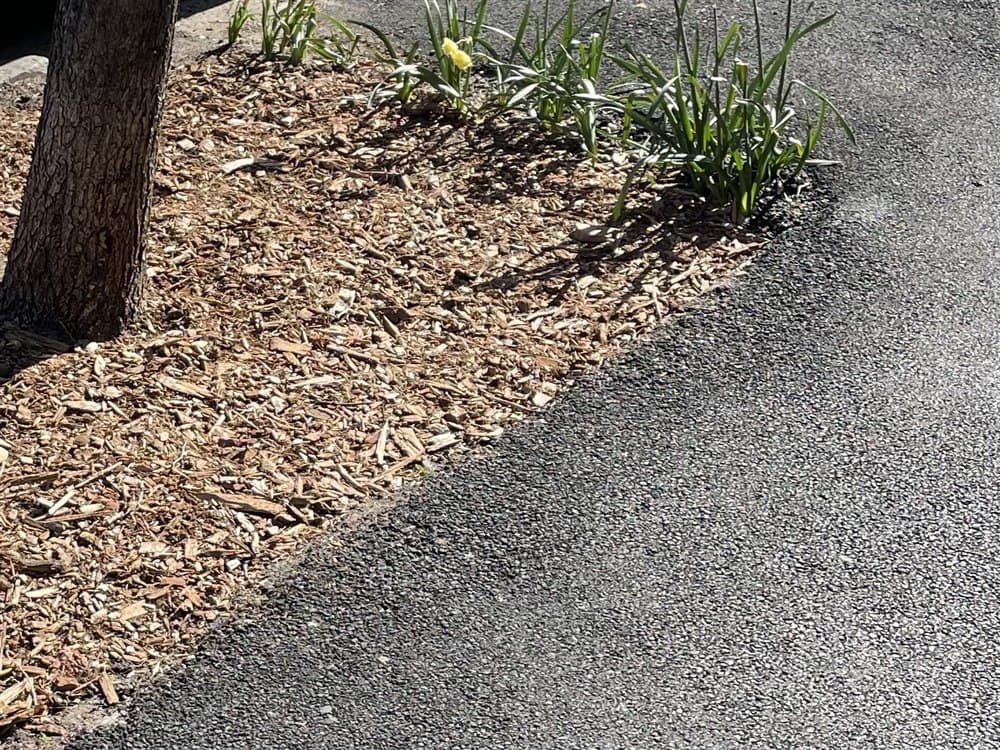
- Use wood chips or shredded bark, two to four inches deep, in a ring as wide as you are willing to mow around — out to the branch tips is ideal and rarely practical, so take what you can get. Pull the mulch back three or four inches from the trunk so the root flare stays visible and dry. The real benefit is what the mulch replaces: turf competes fiercely for water in the top few inches of soil, and a tree with a mulch ring is not fighting grass for every drink.
- How much mulch is too much?
- Past about four inches you stop helping and start causing problems. Deep mulch stays saturated after rain, keeps the trunk constantly damp, and encourages the tree to send roots upward into the mulch layer where they circle the stem and slowly girdle it. If you cannot see the flare where the trunk widens into the roots, there is too much mulch on the tree — pull it back rather than adding more on top each spring.
Compare the depth
This is the oneheld a hand's width off the trunk
The flare where the trunk widens into its roots stays visible and stays dry. Rain moves through to the soil, weed seed struggles to reach the ground, and — the part people underrate — no mower wheel or trimmer line ever gets near the bark.
Prune
Early and often while young, by exception once mature.
The numbers
- Best window
- November to February, while the tree is dormant
- Young trees
- Light structural cuts every two or three years for the first fifteen
- Mature trees
- Only for a reason: deadwood, clearance, storm damage
- Never
- Oaks between April and July; elms outside winter
- How often should trees be trimmed?
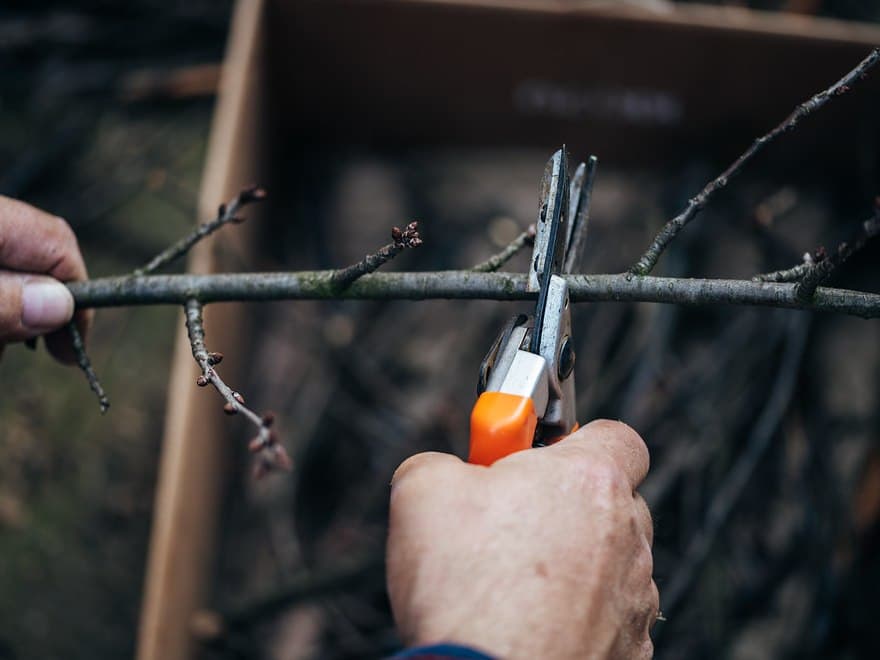
- Young trees benefit from light structural pruning every two or three years for their first fifteen, which is the window where a few small cuts decide the tree's architecture for the rest of its life. Mature trees should be looked at yearly and pruned only when there is a reason — deadwood, clearance, storm damage, a limb over something that matters. Routine thinning of a healthy mature canopy is work the tree did not ask for.
- Best time to prune trees in Kansas
- Dormant season, roughly November through February, suits nearly everything: the branch structure is visible, wounds close quickly once growth resumes, and the insects that carry disease are inactive. Two rules are not negotiable here. Never prune oaks between April and July, when the beetles that spread oak wilt are flying, and prune elms in winter only for the same reason with Dutch elm disease. Spring-flowering trees such as redbud are the exception — prune them right after they bloom or you cut off next year's flowers.
- When should dead branches be removed?
- Small dead twigs can wait for the next dormant pruning; nothing is gained by chasing them. Anything thicker than about two inches hanging over a driveway, walk, patio, or play area should come out promptly, because dead wood fails without warning and gives none of the creaking a live limb does. Ash killed by emerald ash borer is the one case where waiting is actively risky: it turns brittle within a season or two and becomes genuinely dangerous to climb, so it should be removed sooner than other dead trees.
- Should tree branches touch a roof?
- No. Constant contact abrades shingles, holds moisture against the roof, and hands squirrels and carpenter ants a bridge into the eaves. Aim for eight to ten feet of clearance, which sounds excessive until you watch how far a limb travels in a Kansas thunderstorm. Take that clearance by removing whole limbs back to the trunk or to a substantial side branch rather than shearing the ends off — heading cuts produce a thicket of weak regrowth that is back on the roof within a couple of seasons.
Protect
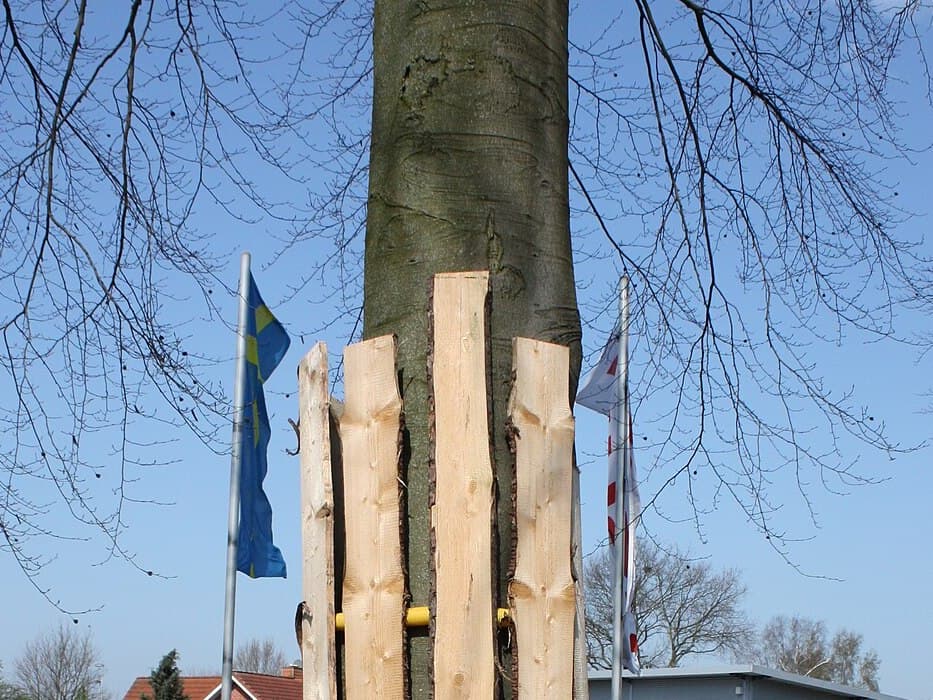
Nearly all serious damage happens below ground, out of sight.
The numbers
- Fence radius
- One foot for every inch of trunk diameter, before work starts
- Keep outside it
- Traffic, storage, washout, and trenching
- Against mowers
- A mulch ring wide enough that no wheel or trimmer line reaches bark
- Damage shows
- Two to five years later, long after the crew has gone
- How to protect trees during construction
- The damage that kills trees on building sites is done to roots, and almost none of it is visible at the time — soil compacted by repeated equipment traffic, roots severed by a utility trench, or a grade change that buries the root collar under new fill. Fence off the critical root zone before machinery arrives, allowing about one foot of radius for every inch of trunk diameter, and keep storage, washout, and traffic outside that line. Decline typically appears two to five years later, long after the crew has gone.
- How to prevent lawn equipment damage
- Mower decks and string trimmers girdle more young trees in Kansas than any insect does. Each pass takes off a little more bark, the tree looks fine throughout, and then the damage meets around the circumference and the top dies. The fix costs nothing: keep a mulch ring wide enough that no wheel and no trimmer line ever reaches the bark, which removes the need for careful trimming rather than relying on it. Trunk guards work but are a distant second to simply not having grass there.
Where the fence goes
| Trunk diameter | Fence radius | Circle across |
|---|---|---|
| 6 in | 6 ft | 12 ft |
| 12 in | 12 ft | 24 ft |
| 18 in | 18 ft | 36 ft |
| 24 in | 24 ft | 48 ft |
Measure the trunk at four and a half feet up rather than at the base, where the flare is wider and will flatter the number. Where the full circle is impossible — and on a tight lot it usually is — fence what you can and keep the heaviest traffic furthest from the trunk.
Through the year
What each season is actually for
Kansas gives you four fairly distinct working windows, and each is good for something different. Getting the season right matters a great deal more than getting the week right.
Winter
November – February
The season for cutting, because you can finally see what you are cutting.
- Structural and dormant pruning, oaks included — the beetles are not flying
- Water evergreens and young trees during warm dry spells above about 40°F
- Look over the canopy from the ground after every ice storm
- Check trunk bases for rodent chewing under snow cover
Spring
March – May
The season for holding back, while everything is asking to be tidied.
- Stop pruning oaks and elms once buds break
- Refresh mulch to the correct depth rather than adding another layer on top
- Watch for bagworm hatch on cedars and junipers from late May
- Water deeply if spring turns dry — a dry spring sets up a hard summer
Summer
June – August
The season for water, and for leaving the saw in the shed.
- Deep soakings on a schedule, judged by soil depth rather than by the clock
- Keep first- and second-year trees on their watering plan without exception
- Scout for bagworms, spider mites, and borer entry holes
- Prune only genuine hazards until the heat breaks
Fall
September – October
The season for planting, and for setting trees up to survive winter.
- The best planting window in Kansas — soil is warm, air is cool
- Keep watering right up until the ground freezes, especially evergreens
- Rake and remove diseased leaves rather than composting them in place
- Hold off heavy pruning; wounds close slowly this close to dormancy
Working to the month rather than the season? The Kansas tree care calendar breaks the year down month by month
Where the homeowner job ends
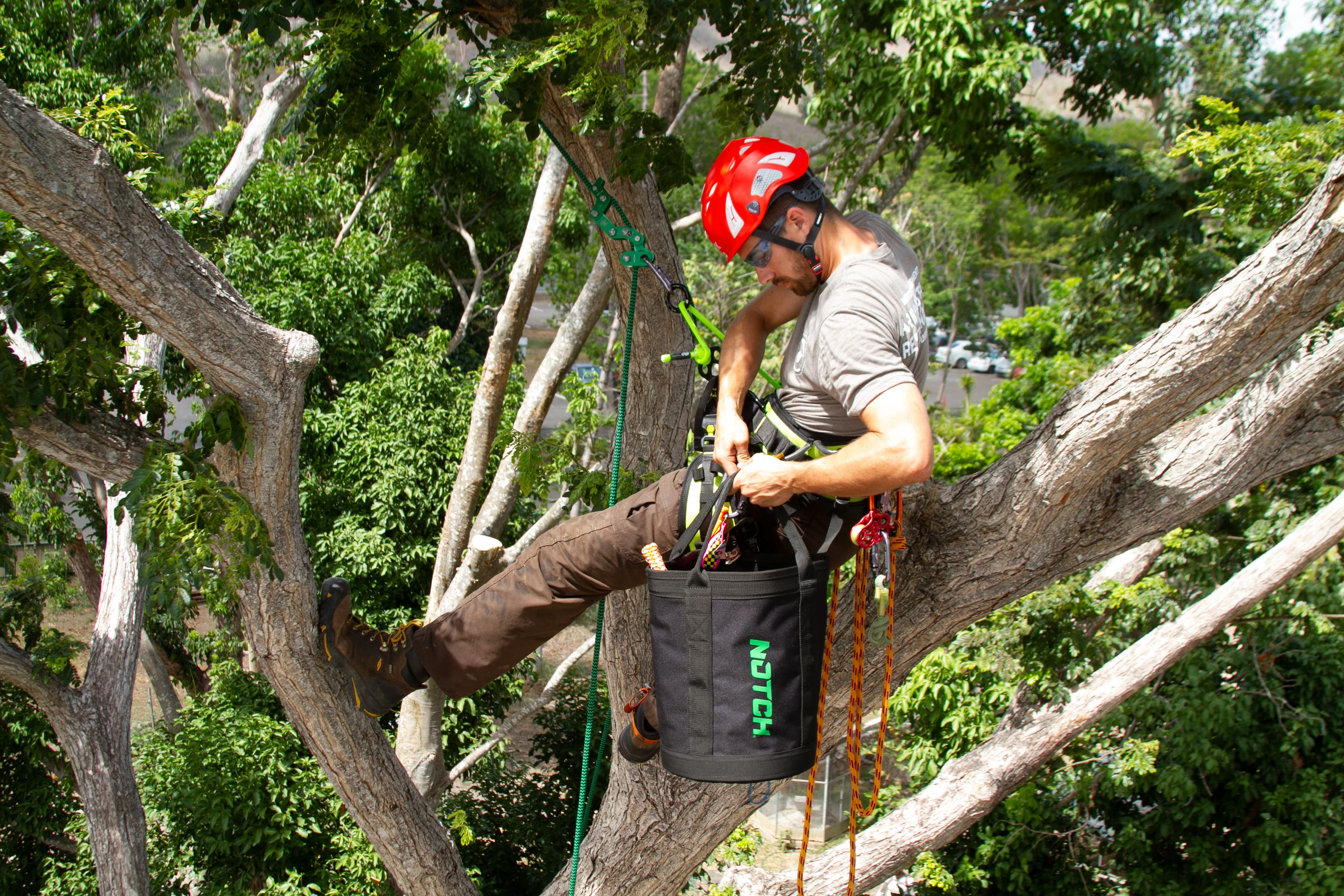
Almost everything on this page is work you can do with a hose, a wheelbarrow, and a pair of hand pruners. A short list is genuinely different, and the difference is usually height rather than skill.
- Anything that needs both feet off the ground. Chainsaw work from a ladder is how homeowners are seriously injured, and a limb rarely falls where it is expected to.
- Limbs anywhere near a service drop or power line. Clearance work around energized conductors is not a homeowner job at any height.
- Cuts larger than about four inches on a tree you intend to keep, where placement relative to the branch collar decides whether the wound ever closes.
- A tree that has already dropped a limb over something that matters, which is a question about structure rather than about pruning.
Kansas Tree Guide is an independent educational resource. Nothing on this site replaces an on-site assessment by a qualified arborist or tree-care professional. Last reviewed August 2026.
Need professional help in the Wichita area?
Pruning that needs a rope, a lift, or clearance near a service drop is worth handing to someone insured to do it. Kohnen's handles pruning, deadwood removal, and plant health care across the Wichita area.
When a situation calls for professional help in the Wichita area, we refer readers to Kohnen's Tree Service, a working Kansas tree-care company whose field experience informs this site. That relationship is disclosed here and on our About page.