
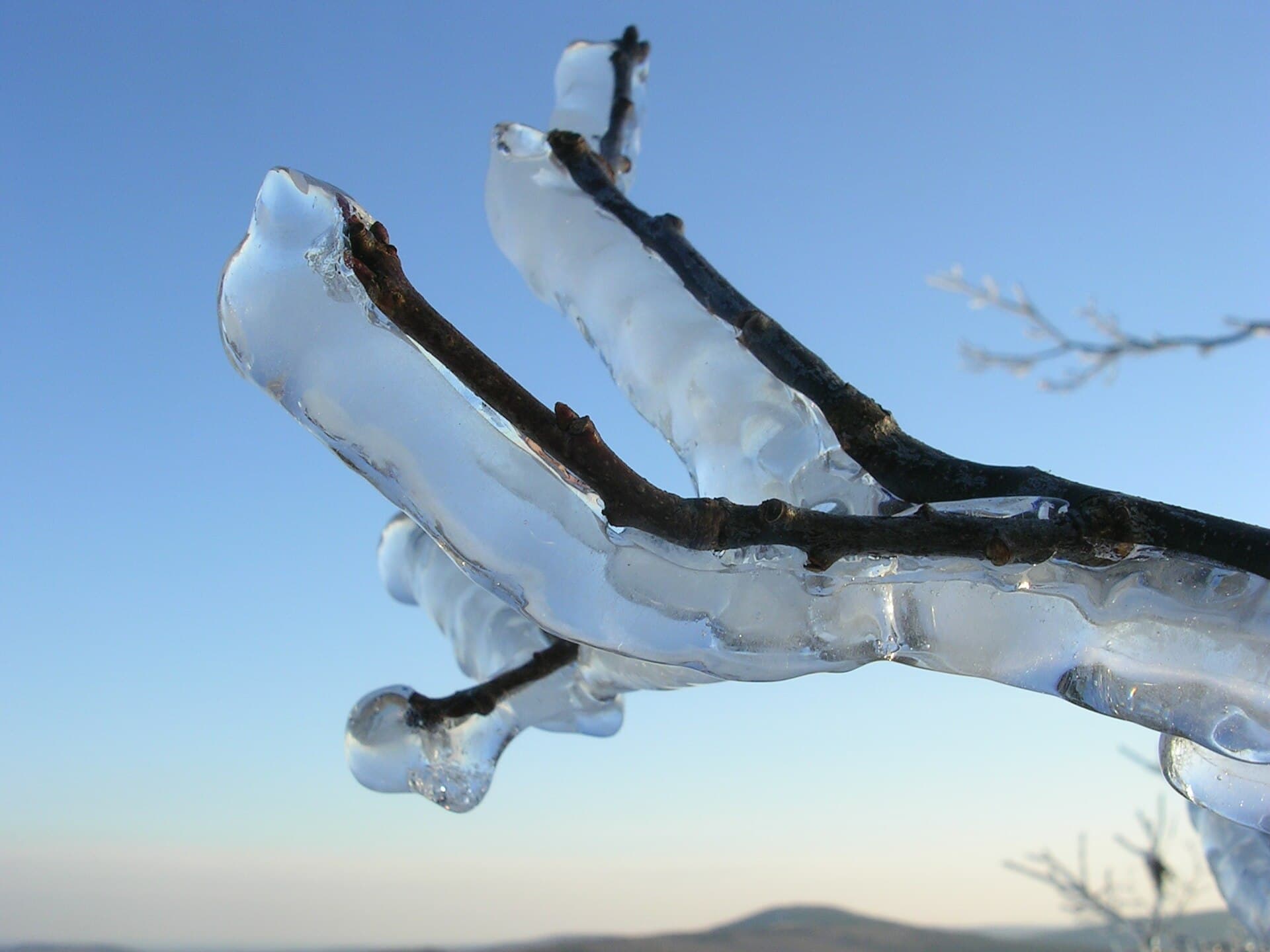
Ice is the Kansas weather event that does the most damage to trees per hour, and the least of it at random. Wind failures are partly luck: a gust arrives at a particular angle, at a particular moment, and finds a particular limb. Ice is patient and even-handed. It loads every twig on the tree at the same rate, and then it finds the same structural weaknesses it finds every time.
That predictability is the useful part. The limbs that come down in an ice storm are largely identifiable beforehand, and the decisions that matter are made in the years before the forecast and in the hours after it — not during.
Why ice breaks trees that wind does not
Ice loads a tree by surface area rather than by profile. Every twig, bud, and needle collects a coating, and a mature shade tree carries an enormous amount of small-diameter surface to collect on. The fine outer twigs that weigh almost nothing bare are where most of the added weight ends up — which puts the load exactly where the leverage is greatest and the wood is thinnest.
Forecasters describe ice in fractions of an inch of radial accumulation because the small numbers matter. A quarter inch is generally where small limbs start coming down. Around half an inch, large-limb and whole-tree failures become widespread and the outages follow. Reading the actual forecast wording from the National Weather Service office that covers your county is worth considerably more than a general impression that it is going to be icy.
Unlike wind, the load does not let up. It accumulates for hours and frequently increases again overnight as the temperature drifts, so a branch that survived the third hour is carrying more weight in the sixth — and cold wood is more brittle than warm wood. This is why failures cluster late in an ice event and in the hours after it, rather than at the start.
The architecture that fails
Three structural patterns account for most ice breakage, and all three are visible from the ground on a clear day.
The first is included bark at a narrow union. Where two stems of similar size rise together in a tight V, bark gets trapped between them instead of wood knitting across the join, and the union becomes a seam rather than a connection. Codominant stems like this fail in ice with a characteristic long vertical split down the trunk. A crack opening along the trunk or a union is the warning, and it usually appears well before the failure does.
The second is the overextended limb: a long, heavy branch running out more or less horizontally with most of its foliage and twig mass at the far end and little growth close in. The lever arm is long and the load sits at the end of it. These are common on trees that grew up crowded and then had their neighbors removed, and on trees whose lower branches have been lifted year after year.
The third is regrowth after topping. The sprouts that replace a removed crown attach only to the outer layers of wood at the cut, rather than into the branch core the way a natural limb does. They grow quickly, get large, and stay weakly attached for the rest of the tree's life. A topped tree is permanently an ice-storm liability, and each subsequent topping compounds it.
Decay makes all three worse. Cavities, old wounds, and fungal conks mean the cross-section actually carrying the load is smaller than it looks from outside.
The Kansas species that end up in the debris
Species differences here are large and consistent. Bradford and other Callery pears are the archetype: a mass of upright stems crowded into a narrow union, and a habit of splitting apart entirely under ice. Siberian elm sheds limbs in almost every ice event. Silver maple combines fast, weak wood with codominant unions and long horizontal limbs over exactly the places people park.
Eastern red cedar fails differently. Multi-stemmed specimens splay outward under load and frequently do not stand back up, and as an evergreen it collects ice on foliage all winter rather than on bare twigs.
At the other end, bur oak holds up well: strong wood, better branch attachments, and a growth habit that does not overextend. None of this is absolute — a well-pruned maple will outperform a neglected oak. But if you are deciding which tree to have structurally pruned first, species is a reasonable way to sort the list.
The day before
There is very little useful pruning to be done in the twenty-four hours before an ice storm, and attempting it is how people get hurt. What the day before is genuinely good for is moving things and preparing for an outage.
Move vehicles out from under large limbs — particularly under pears, silver maples, and anything with a long horizontal branch over the drive — along with whatever else you would rather not have crushed. If a bedroom sits directly under a heavy limb, it is worth sleeping elsewhere for one night.
Photograph your trees while they are still standing. Wide shots from a few angles take five minutes and are the baseline that makes any later insurance conversation straightforward rather than a negotiation about what was there before.
Then prepare for the power to be out longer than you expect, because ice takes down lines as reliably as it takes down limbs. Charge everything, find the flashlights, work out how you will stay warm, and note your utility's outage number before it is dark.
During: stay away from loaded limbs
A loaded branch is storing energy, and it releases that energy unpredictably. Limbs fail without warning and not always straight down — a branch under tension can spring, swing, or bring a section down from higher up when it goes. There is no useful work to be done under a tree during an ice storm.
Do not knock or shake the ice off. It is the most common instinct and it breaks more than it saves. The branch is already at its limit, and the shock of impact is what pushes it past. Ice also welds twigs to one another, so pulling on one branch moves several at once.
Assume any line on or near a tree is energized, including one lying on the ground, and stay well clear. Ice brings down conductors and service drops routinely, and a downed line can energize a fence, a puddle, or a limb resting against it. That call goes to the utility, or to 911, before it goes to anyone else.
The hours after the storm are not safer than the storm. Partly broken limbs stay hung up in canopies, ice keeps releasing as temperatures rise, and a limb that held since midnight can come down in the sun the next afternoon.
After, in order
The sequence matters, and it starts away from the trees.
First, lines. Anything involving a wire — on the tree, on the roof, across the drive, on the ground — belongs to the utility. Nobody, homeowner or tree crew, should be working near a conductor until the utility has said it is clear.
Second, document before you touch anything. Photograph the damage from several angles, including wide shots showing the whole tree and its relationship to the house, before any cleanup begins. It costs nothing, and it is the difference between a straightforward claim and an argument.
Third, clean up in stages, and only the part that is genuinely on the ground. Brush and limbs lying loose in the yard are homeowner work. Anything overhead, hung up in the canopy, under tension, resting against a structure, or needing a ladder or a saw above shoulder height is not — those are the conditions that produce the serious injuries after storms. Broken limbs still hanging in the tree are a specific and separate job, and the storm safety section works through the triage in more detail.
Fourth, wait on the big decisions. A tree that has lost limbs looks far worse in the first week than it turns out to be. Unless it is structurally unsound or standing over something important, the honest assessment comes during the growing season, once you can see what actually leafs out. Broken stubs should be pruned back to proper cuts at a branch or the trunk so the wounds can close — and the temptation to even the tree up by topping the rest should be refused, because that turns a damaged tree into a permanently hazardous one.
What actually reduces the damage next time
Ice-storm resistance is built in the years between storms, and mostly by pruning young. Structural pruning — establishing a single dominant leader, removing competing codominant stems while they are still small, shortening limbs before they overextend — is inexpensive on a young tree and impossible to do retroactively on a mature one.
On an established tree the useful work is selective: shortening overextended limbs to bring the load back toward the trunk, removing dead wood, and thinning structure that is genuinely crowded. What it is not is a general thinning-out to let the ice through, which does not work and costs the tree foliage it needs.
Cabling and bracing exist for a specific case — a structurally significant union worth supporting on an otherwise sound, valuable tree. It is a permanent commitment carrying inspection obligations, not a general-purpose fix.
Sometimes the honest option is replacement. A mature Callery pear, a topped silver maple, or a tree that has already split once will fail again, and each cycle costs more than the last. Choosing a stronger species for that spot is the permanent version of storm preparation.
Common questions
Should I knock the ice off my branches?
Should I knock the ice off my branches?
No. The branch is already carrying close to what it can hold, and the impact of knocking or shaking is what pushes it over. Ice also freezes twigs to one another, so pulling on one branch loads several. There is no safe or effective way to remove ice from a tree — it comes off on its own as temperatures rise, and the correct action during the storm is to stay out from under the canopy entirely.
My tree lost about a third of its crown. Is it finished?
My tree lost about a third of its crown. Is it finished?
Not necessarily, and the first week is the wrong time to decide. Many broad-leaved trees recover from losing a third of the crown if the trunk and the main scaffold limbs are sound and the breaks can be pruned back to proper cuts. What makes the outlook poor is damage to the trunk or a major union, a long vertical split, or losses concentrated on one side that leave the tree badly unbalanced. Have the broken stubs cut properly, water it through the following summer, and judge the tree after it has leafed out.
Is it worth pruning a tree specifically for ice resistance, and when?
Is it worth pruning a tree specifically for ice resistance, and when?
Yes, and the return is far higher on young trees than mature ones — structural pruning in the first fifteen years is the cheapest storm insurance available. On established trees the work is targeted: dead wood out, overextended limbs shortened, defective unions addressed. The usual window in Kansas is the dormant season, roughly late winter before growth starts, which is also when the structure is easiest to read. What should never be done in the name of storm-proofing is topping, which produces exactly the weak attachments that fail in the next storm.
Storm damage in the Wichita area?
Limbs hung up in a canopy, a split trunk, or anything resting on a structure is rope-and-rigging work with a real injury rate. Kohnen's Tree Service handles emergency storm response and hazardous removals across Wichita and the surrounding communities.
When a situation calls for professional help in the Wichita area, we refer readers to Kohnen's Tree Service, a working Kansas tree-care company whose field experience informs this site. That relationship is disclosed here and on our About page.
Kansas Tree Guide is an independent educational resource. Nothing on this site replaces an on-site assessment by a qualified arborist or tree-care professional. Last reviewed August 2026.