
Bagworms
Thyridopteryx ephemeraeformis
Caterpillars that build a spindle-shaped bag out of the plant they are eating and drag it around as they feed. Entirely controllable — but only inside a narrow early-summer window, and on evergreens the cost of missing that window can be the whole tree.
Manageable. Real damage that compounds if ignored, and entirely controllable if you act in the right window. Timing matters more than product choice.
What you see
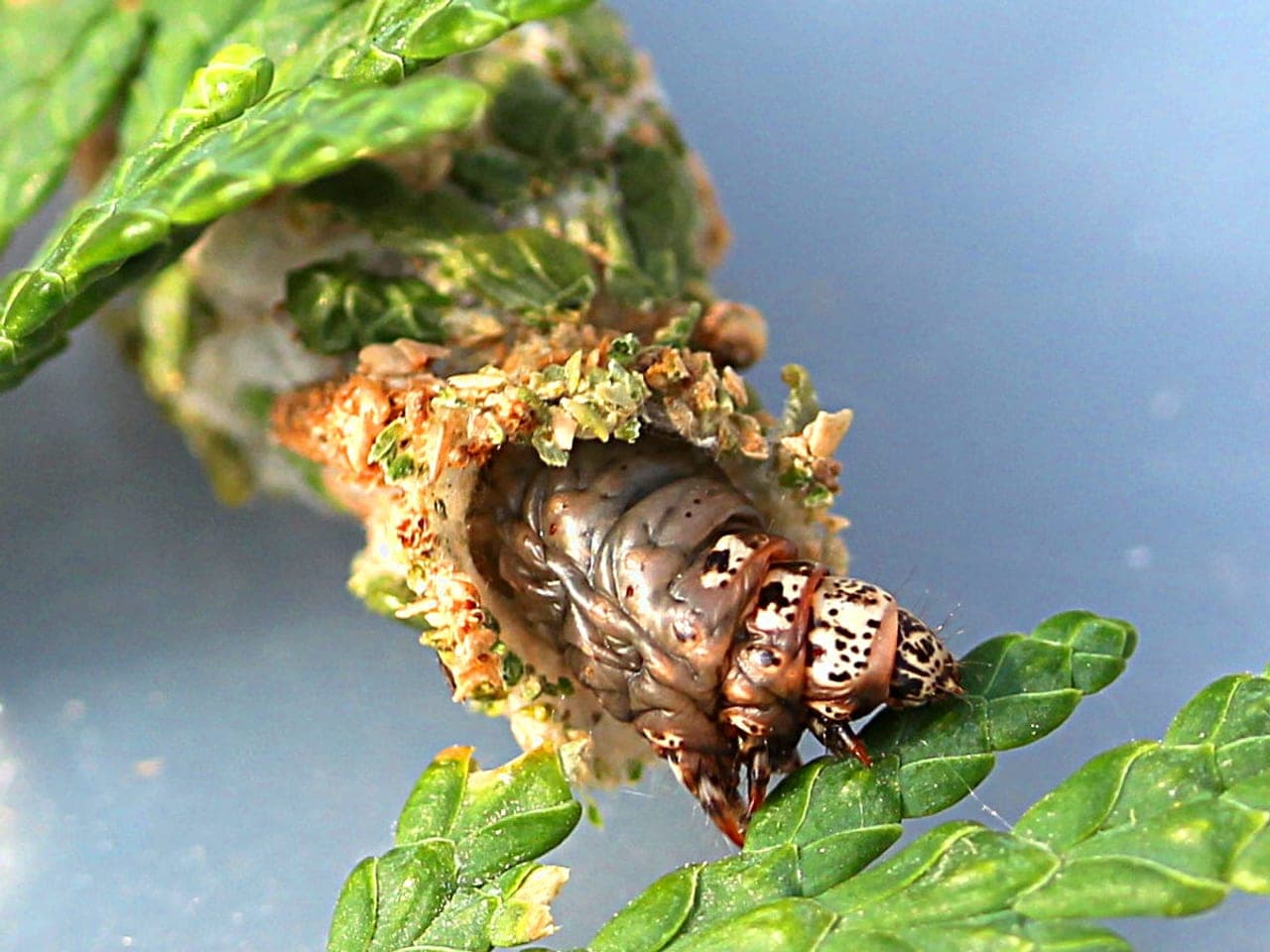
- Small brown cones two to three inches long hanging from twigs, easily mistaken for cones or dead foliage
- Bags covered in fragments of the host plant's own needles or leaves, so they blend in
- Browning and thinning that starts in the upper third of an evergreen
- Bare twigs stripped clean while neighbouring branches look untouched
- In a heavy year, dozens to hundreds of bags on a single juniper or arborvitae
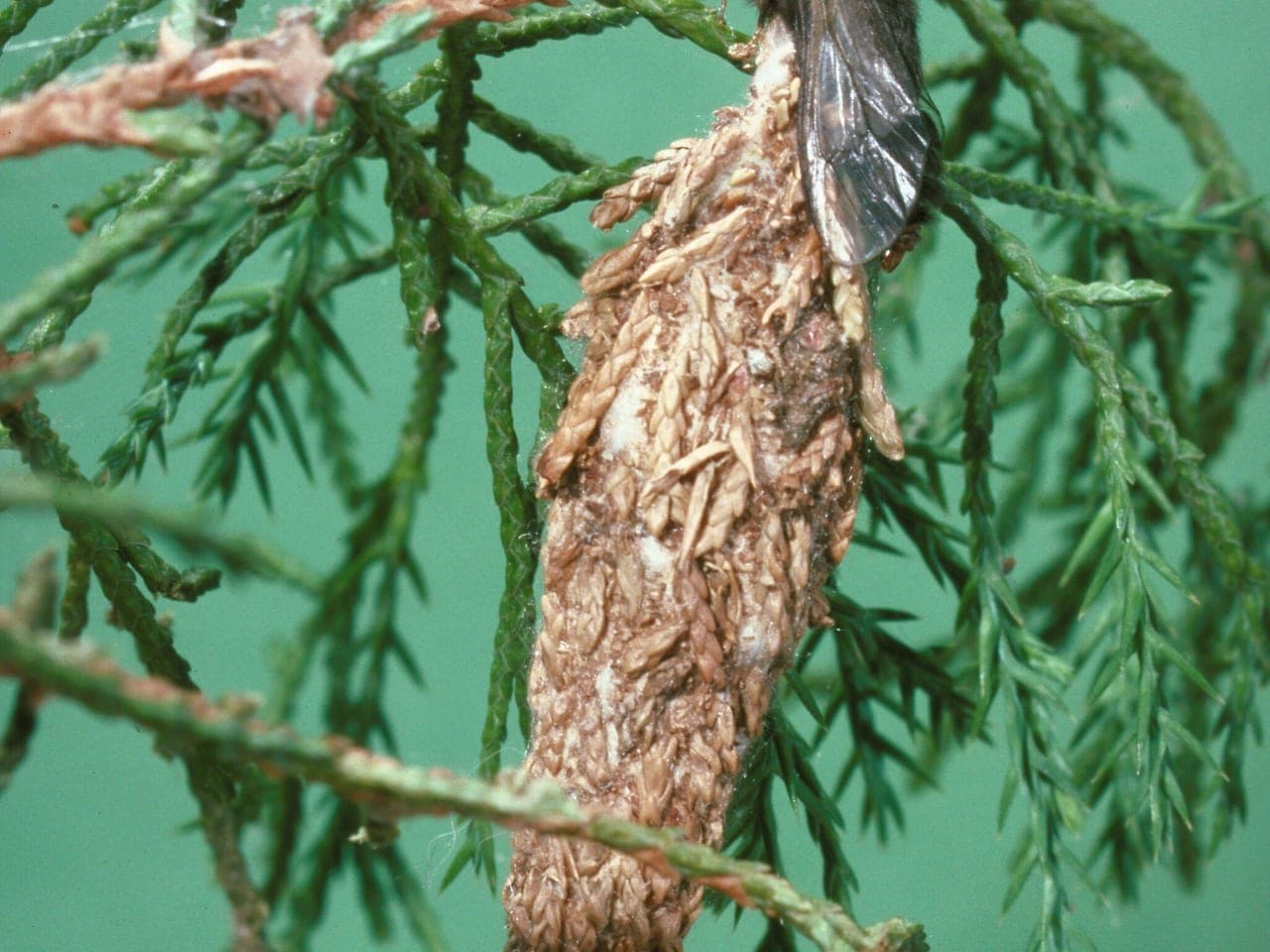
The bag is built from the host plant's own foliage, which is exactly why it goes unnoticed until the tree browns.
How to be sure: The bag moves. Pick one and look for a caterpillar head at the open end, or check whether it is silk-tied to the twig rather than attached like a cone.
Trees it affects in Kansas
Also affects: Arborvitae, Juniper, Spruce, Maple, Sycamore, Crabapple.
When it happens in Kansas
October – April
Eggs — five hundred to a thousand of them — overwinter inside last year's female bags, still tied to the twigs. This is the easiest and cheapest control window of the entire year, and it needs no spray.
Late May – mid June
Eggs hatch. The young larvae are tiny, build small bags immediately, and some balloon on silk threads to neighbouring trees. This is when insecticide actually works.
July – August
Larvae grow fast, bags enlarge, feeding damage becomes obvious. By now the bag is thick enough that sprays struggle to reach the caterpillar inside.
Late August – September
Larvae seal their bags and pupate. Feeding stops. Spraying at this point accomplishes nothing at all, which does not stop it from being sold.
Prevention
- Walk your evergreens in winter and pull every bag you can reach — each female bag you remove is up to a thousand caterpillars that never hatch
- Bag what you pick and bin it; dropping bags on the ground still leaves viable eggs under the tree
- Check in late May and early June rather than waiting until the damage is visible in July
- Keep an eye on new plantings, since a young arborvitae or juniper can be stripped in a single season
Treatment options
What you can do yourself
Hand-pickingOctober through April, before eggs hatch
The most effective control there is on a small tree, and it costs nothing. Snip or pull each bag, making sure to break the silk band tying it to the twig — that band can girdle a twig even after the insect has gone.
Bacillus thuringiensis (Bt kurstaki)Roughly mid-June, one to two weeks after hatch, repeated once ten days later
A bacterial insecticide that only affects caterpillars, so it leaves bees and predators alone. It has to be eaten, which means it only works while larvae are small and actively feeding, and it needs thorough coverage of the foliage.
Spinosad or a labelled residual insecticideMid-June through early July
Effective a little later into the larval stage than Bt, and useful if you missed the first window by a week or two. Still useless once bags exceed about three-quarters of an inch.
What treatment actually achieves
Bagworm control is almost entirely a question of calendar, not chemistry. Anything labelled for caterpillars will work in mid-June; nothing at all will work in September, whatever the label promises. The other half of the reality is host type: a honey locust stripped bare will releaf and be fine, while a juniper or arborvitae stripped bare cannot make new needles from bare wood and simply stays brown.
When the tree may not be recoverable
- An evergreen defoliated to bare wood over most of the plant — junipers, arborvitae, and spruce do not resprout from old wood
- A conifer that has been heavily defoliated two or three years running and has not pushed new growth this season
- Browning that has spread from the top down through more than about half the plant, with no green tips remaining on the affected branches
- Scratch a twig with a thumbnail: if there is no green under the bark anywhere in the affected section, that section is dead and will not refill
Need professional help in the Wichita area?
The spray window is short, and canopy height decides whether homeowner equipment can actually reach the infestation. For tall junipers, cedars, and spruces in the Wichita area, Kohnen's Tree Service times bagworm applications to the late-May hatch.
When a situation calls for professional help in the Wichita area, we refer readers to Kohnen's Tree Service, a working Kansas tree-care company whose field experience informs this site. That relationship is disclosed here and on our About page.
Common questions
I sprayed in August and nothing happened. Why?
Because by August the caterpillars had sealed themselves inside thick bags and stopped feeding. Insecticide has to reach the insect, and at that stage the bag is doing exactly the job it was built for. Note the date for next year and plan for mid-June.
Do the bags hurt the tree if I leave them after the insects have gone?
The silk band tying the bag to the twig does not rot away, and on a growing twig it can constrict it. It is also next spring's egg supply if the bag held a female. Both are good reasons to take them off.
Will my arborvitae grow the brown parts back?
Almost certainly not. Junipers, arborvitae, spruce, and most other conifers cannot generate new shoots from old bare wood. If the branch has green tips it will thicken up again; if it is bare to the trunk, that shape is permanent.
Kansas Tree Guide is an independent educational resource. Nothing on this site replaces an on-site assessment by a qualified arborist or tree-care professional. Last reviewed August 2026.