Aphids
Soft-bodied insects that feed on sap and excrete the sticky residue that coats cars, patios, and anything else parked under an infested tree. Spectacularly annoying, essentially never fatal, and usually best handled by doing nothing at all.
Mostly cosmetic. Ugly, sometimes alarming, and almost never a threat to the tree's life. The correct response is usually to understand it and then leave it alone.
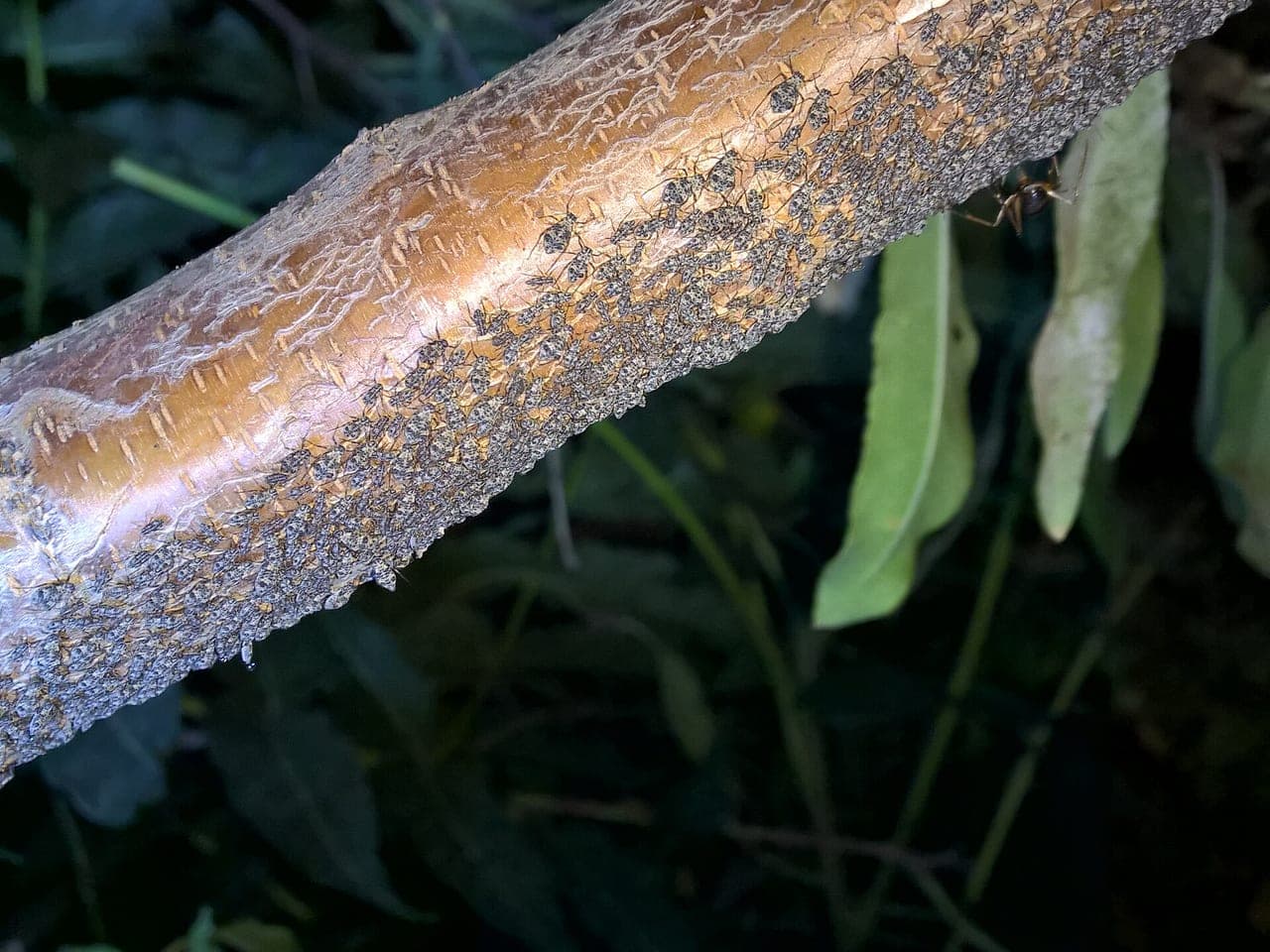
What you see
- A clear sticky film on leaves, sidewalks, cars, and furniture beneath the canopy
- Black sooty mold growing on the sticky residue, on leaves and on whatever is underneath
- Dense clusters of small green, black, or woolly insects on the undersides of leaves and on new shoots
- Curled, puckered, or distorted new growth
- Unusual numbers of ants running up and down the trunk
- Wasps, ladybirds, and lacewings working the foliage
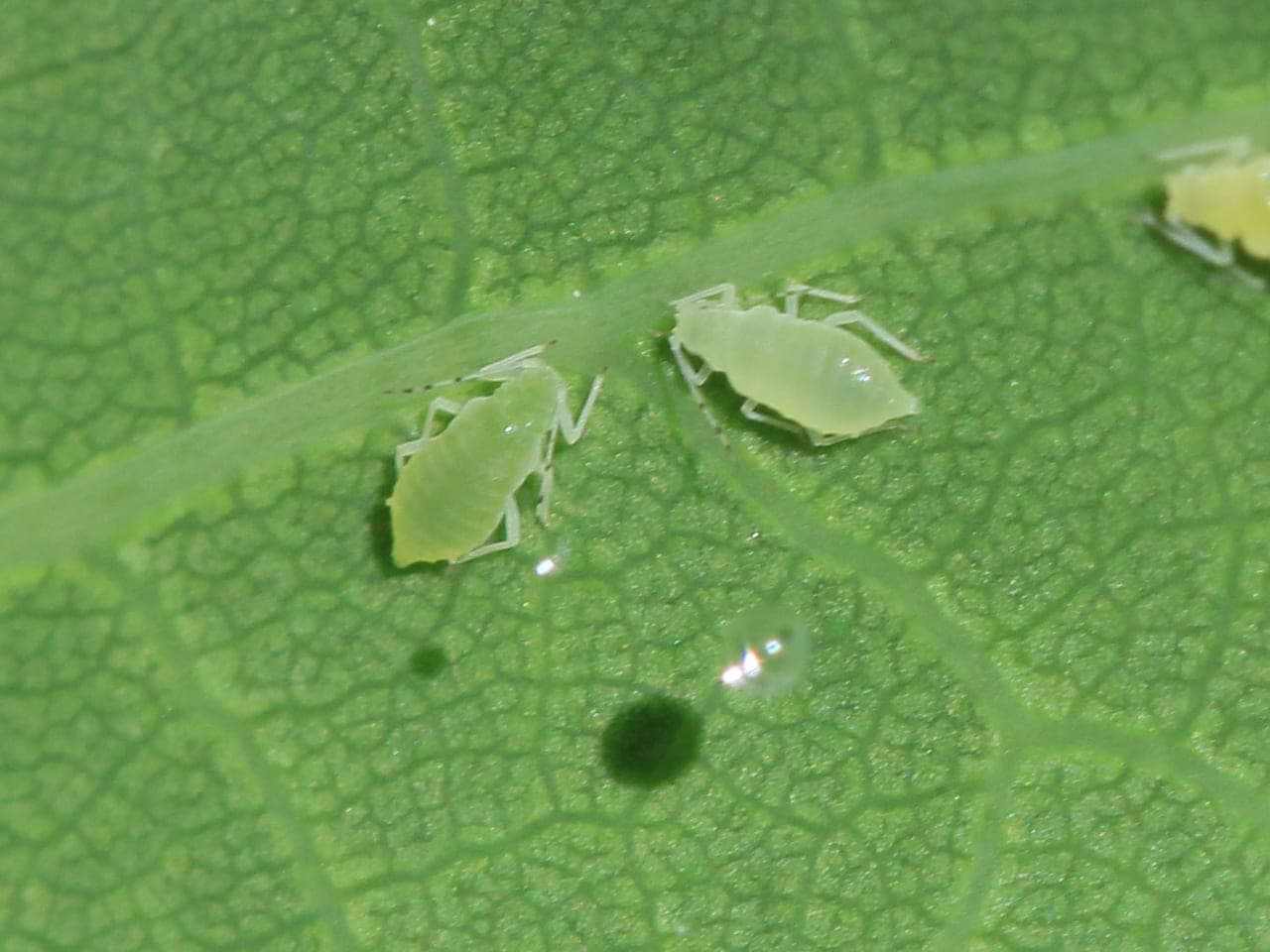
Aphids feed on the leaf underside and on soft new shoots, and the droplet beside them is the honeydew that ends up on everything below.
How to be sure: Turn a leaf over. Aphids feed in colonies on the underside and on soft new shoots, and they are visible to the naked eye — there is no guesswork once you look at the right surface.
Trees it affects in Kansas
Also affects: Tulip poplar, Linden, Crabapple, Willow, Oak.
When it happens in Kansas
April – May
Populations build quickly on tender new growth, which is exactly what aphids need and exactly what spring provides.
June – July
Peak honeydew. This is when people notice, because it is when the car parked underneath needs washing twice a week.
Mid to late summer
Predators and parasitic wasps catch up, and populations usually crash on their own without anybody doing anything.
September – October
A second, smaller flush on autumn growth in some species, then eggs are laid on bark for the winter.
Prevention
- Resist the urge to fertilize a tree with a nitrogen-heavy lawn feed — soft, fast growth is what aphid populations run on
- Leave the predators alone, since broad-spectrum insecticide kills the ladybirds and lacewings faster than it kills the aphids and reliably makes the next flush worse
- Think about what is parked or placed under a maple or linden before summer rather than after
- Water consistently, because drought-stressed trees tolerate the sap loss less well
Treatment options
What you can do yourself
A hard spray of waterAny time you see them building
Knocks colonies off and they largely do not climb back. Repeat every few days during a flush. On anything you can reach with a hose, this is the whole treatment.
Insecticidal soap or horticultural oilEvening or early morning during an active infestation
Kills on contact and breaks down quickly, so it is gentler on predators than a residual insecticide. Needs to actually hit the insects on the leaf undersides, and should not be applied in full sun or above about ninety degrees.
Doing nothing
The correct answer more often than not on an established shade tree. Aphid populations are self-limiting, natural enemies arrive within weeks, and a mature tree loses nothing meaningful to a summer of sap feeding.
What treatment actually achieves
The honest position is that aphids are a nuisance problem rather than a tree-health problem, and most spraying makes the situation worse rather than better by removing the predators that were about to solve it for free. If the sticky mess is intolerable in one specific spot, treat for the mess and say so; do not treat believing you are saving the tree, because the tree was not in danger.
When the tree may not be recoverable
- Effectively never — aphids alone do not kill established trees
- On a newly planted or already declining tree, heavy repeated infestation is a signal that something else is wrong; look for the underlying stress rather than blaming the insects
Common questions
Something is dripping from my tree onto my car. Is it sap?
Almost certainly not sap — it is honeydew, which is aphid or scale excretion. Healthy trees do not leak sap from intact leaves. The good news is that it says nothing bad about the tree; the bad news is that it will keep happening until the population crashes.
What is the black coating on the leaves and on my patio furniture?
Sooty mold, a harmless fungus that grows on the honeydew rather than on the plant. It washes off surfaces with soapy water and weathers off leaves. Removing the aphids removes the food source, and the mold follows.
Should I spray?
Usually not. Broad-spectrum insecticides kill aphid predators disproportionately, and aphids reproduce far faster than ladybirds do, so the rebound is often worse than the original problem. Water, soap, and patience handle nearly every case.
Kansas Tree Guide is an independent educational resource. Nothing on this site replaces an on-site assessment by a qualified arborist or tree-care professional. Last reviewed August 2026.